Dwarskersbos and the Day the Ocean Spoke: The 1969 Meteo-Tsunami and a Coastal Legacy
Nestled quietly on South Africa’s West Coast, Dwarskersbos is a village where stories wash ashore with every tide. Among its most fascinating tales is one that begins not with thunder or tremors, but with stillness—followed by a wave that came from nowhere.
On August 27, 1969, this peaceful town experienced a rare and mystifying phenomenon: a meteo-tsunami. Unlike typical tsunamis triggered by earthquakes, this event was caused by atmospheric conditions. Today, Dwarskersbos remains not only a scenic seaside retreat but also a site of international scientific intrigue.
At Dwarskersbos Accommodation, we invite you to explore the story behind this unique coastal event and relax in the same serene setting—our collection of beachfront homes is available to book now at dwarskersbos.net.
The 1969 Wave: A Historical Event Unlike Any Other
In the early morning hours, a sudden wave struck the coastline of Dwarskersbos. It surged across dunes, flooded homes, and pushed small boats far inland. Yet, curiously, no earthquake or storm had occurred. Residents were left shocked. What could have caused such an intense, isolated wave?
In 2010, researchers returned to Dwarskersbos to investigate the 1969 event. They interviewed nine elderly residents who had witnessed the wave firsthand. These local testimonies, combined with physical measurements, suggested that the wave towered between 20 and 30 feet (over 6 meters) and traveled up to 260 meters inland, affecting a concentrated 2-kilometer stretch of coast. Nearby towns like Elands Bay, Lamberts Bay, and St. Helena Bay remained completely untouched, underscoring just how localized and extraordinary the event truly was.
This puzzling localization raised many questions, prompting a full scientific investigation.
The Science Behind the Surge
In 2013, a landmark study titled “The rogue wave of 27 August 1969 at Dwarskersbos, South Africa: a field survey and simulation” was presented at the European Geosciences Union General Assembly by Oebius et al. Their research brought clarity to the mystery.
Using numerical simulations and coastal modeling techniques refined through the study of other historical tsunamis—including the 1946 Aleutian and 1956 Greek events—researchers concluded that the wave was caused by a meteorological squall traveling at 18 m/s (about 65 km/h). As it moved across St. Helena Bay, it generated a resonant gravity wave in the shallow waters just offshore of Dwarskersbos.
This resonance amplified the wave’s energy, creating a powerful, localized surge. The phenomenon is known as a meteo-tsunami—a rare atmospheric-driven ocean wave—and Dwarskersbos is now one of the few documented places on Earth to have experienced one.
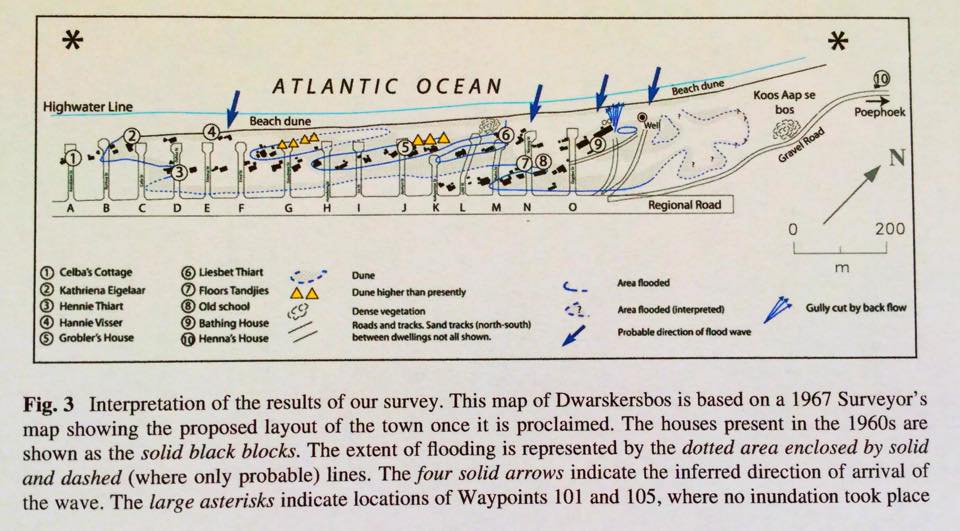
Image by Johan Visser. Simulation of the 1969 Dwarskersbos meteo-tsunami. The model shows how a sudden drop in air pressure, caused by a westerly wind of about 65 km/h, generated a gravity wave that struck the coast from the NNW, flooding the area. The strongest backwash damage occurred at the Badshuise. Note that the reference streets shown in the illustration did not exist at the time.


Newspaper clippings reveals the dramatic 1969 meteo-tsunami – kindly shared by Stiaan Binneman.
Echoes of the Past
The memories of that remarkable day live on through the voices of those who experienced it firsthand. Many of these stories were shared on Facebook, and we are deeply grateful to everyone who contributed, helping to preserve this unique piece of Dwarskersbos history. The 1969 meteo-tsunami was more than just an extraordinary natural event—it was a moment that touched the lives of everyone in the village. Through these shared recollections, we see how the community came together, supported one another, and strengthened the bonds that make Dwarskersbos such a special place. Each story, each memory, is a living thread connecting past and present, reminding us of the resilience and spirit of those who lived through that unforgettable day.


A collection of old newspaper clippings from 1969, featuring photos and stories of residents who experienced the Dwarskersbos Meteo-tsunami — kindly shared by Erna Mostert and Stiaan Binneman.
Moments That Stayed: Memories Shared on Facebook from Those Who Lived It
- Stiaan Binneman:
I remember it like yesterday. Oom Jan called my late father, shouting that the house was under water. My dad was already knee-deep as he climbed out of bed. Oom Jan pulled me through the window. A full cage of birds drowned, except for one little quail. The bakkies that had been parked by the dune were carried by the water and dumped behind the tree in front of the house.
Down at the Badshuise, the wave gouged a hole where it broke. I think it didn’t come directly from the sea, but more from the north. Had it come straight from the sea, the water probably would have reached all the way to Rosyntjiedam — we wouldn’t be here today. Directly after the wave, the water was as low as at spring tide.
It’s really a shame that many of the older people who experienced it never wrote about it.
- Gerhard Visser:
My father and I had carted gravel from the sea the night before, but by the next morning, it had all vanished, along with the thousand pieces of rooikrans wood we had collected — only mud, debris, and dead fish remained. Water stood 18 inches high on our stoep. At the time, the water tower was under construction, and the builders had watched the wave come in. Luckily, no lives were lost, and I’m glad we can tell the story today.
- Riana Thiart Schreuder:
We will never forget it. When we woke up, all our loose mats and shoes were floating in the water.
- Marinda Visser Thiart:
Stepping out of bed straight into knee-deep water was a shock. School was cancelled that day so we could help the older people. We ran around the farm checking on everyone. For us kids, it was an adventure, but the elders didn’t find it funny.
- Sue Anne van Jaarsveld:
Our grandparents house was spared, but our grandfather’s pigsty was washed away. I remember he marked the wall where the water had reached. I had to stand on tiptoe to touch the mark. The little fish were still flopping in the pools, and the ditches at the Badshuise were so deep that I couldn’t see over the banks when I stood in the ditch. I must say, I was afraid of the sea for a long time after that — afraid of the next one.
- Ollie Colombo:
I can clearly remember that we drove from Stompneusbaai to check if everything was okay with Tannie Soesie Verkeul (my father’s sister). She told us how she stood by the back door watching her son Pieterjie drift past on a mattress with a field mouse on his chest.
- Erna Mostert:
My grandparents’ house in Dahlia Street was also flooded. I remember my parents fetching us early from school to help clean up. At that time, there was no houses next to or in front of ours — only bushes. A dirt road ran from our house to Oom Willem Bos and, if I remember correctly, Oom Klaas’ house, with Oom Hennie’s house further down the road and Oom Wynwa’s house on the other side. After the tsunami, the entrance to the house was moved to the side instead of facing the sea.
- Marius Huysamen:
My father said they were still at the beach that evening, busy with foot-netting (Voetseen trek). Just after reaching Seefontein, the tsunami hit.
A Note About These Memories
We’ve done our best to capture the memories shared by local residents. Some details may have been summarized or slightly adapted for clarity.


Newspaper clippings documenting the 1969 meteo-tsunami — kindly shared by Erna Mostert and Natasha Tolken Smit
Dwarskersbos Today:
Peaceful, Scenic, and Full of Stories – A Coastal Retreat with a Historic Heart
Today, Dwarskersbos is tranquil once again—a peaceful coastal haven where the only waves are those gently lapping the shore, and the only surprises are the graceful breaches of whales or the playful dance of dolphins in the surf. Blending rich history, unspoiled nature, and a rare stillness, it offers a truly unique experience on South Africa’s West Coast. Whether you’re captivated by the mystery of the 1969 meteo-tsunami or simply in search of serenity by the sea, Dwarskersbos Accommodation provides the perfect home base. The wave that once made headlines now enhances the allure of a destination known for golden sunsets, endless beach walks, and a calm that lingers long after your visit.
Experience the history of Dwarskersbos and the stories that shaped our coastal village.
👉 Visit Dwarskersbos Accommodation to view our homes and book your stay
References
- Oebius, R., Rabinovich, A. B., & Guza, R. T. (2013). The rogue wave of 27 August 1969 at Dwarskersbos, South Africa: a field survey and simulation. European Geosciences Union General Assembly 2013, EGU2013-1571. Retrieved from https://ui.adsabs.harvard.edu/abs/2013EGUGA..15.1571O/abstract
- Rabinovich, A. B., & Monserrat, S. (2009). Meteorological tsunamis. In E. Pelinovsky & T. Talipova (Eds.), Tsunami – A growing disaster (pp. 369–403). Springer. DOI: 10.1007/978-1-4020-9342-8_13
- Monserrat, S., Vilibic, I., & Rabinovich, A. B. (2006). Meteotsunamis: Atmospherically induced destructive ocean waves in the tsunami frequency band. Natural Hazards and Earth System Sciences, 6(6), 1035–1051. DOI: 10.5194/nhess-6-1035-2006
- Interview data referenced from the 2010 field survey as cited in Oebius et al. (2013), based on oral testimonies from residents of Dwarskersbos.
- Netwerk24. (Various years). News articles and archival material on the 1969 Dwarskersbos tsunami. Retrieved from https://www.netwerk24.com
- Facebook. (2024). Community-shared memories of the 1969 Dwarskersbos tsunami. Retrieved from Dwarskersbos community pages and groups.